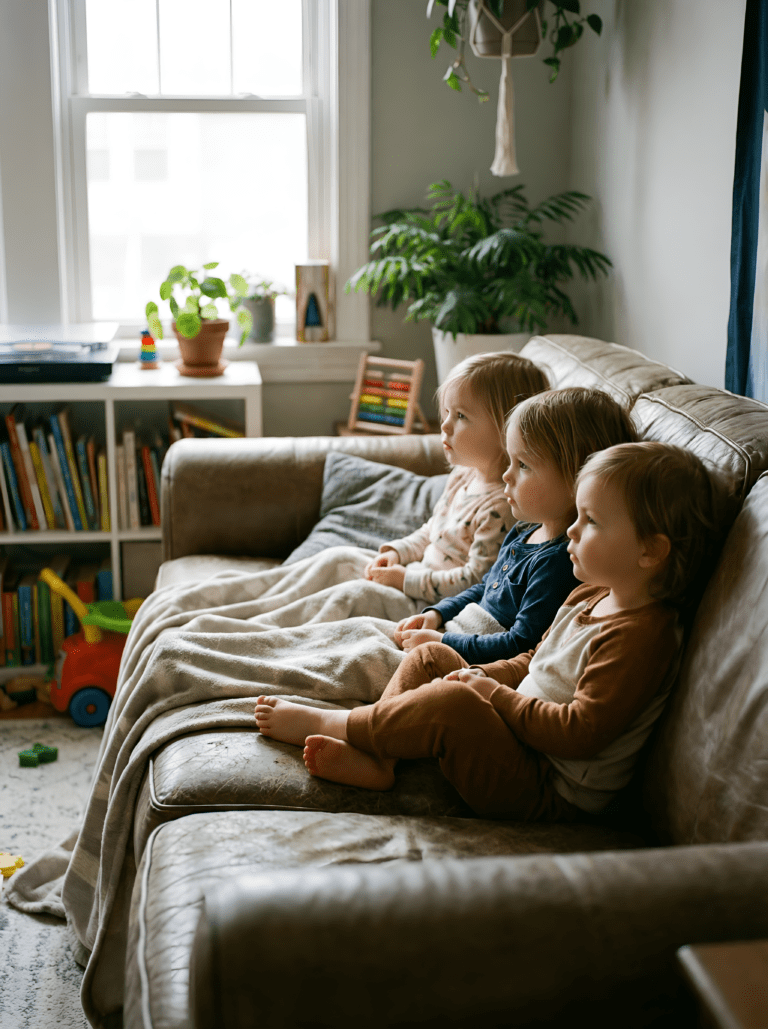
My daughter just turned two and a half, and I still remember those early months when I felt completely overwhelmed by the screen time question. The American Academy of Pediatrics says no screens before 18 months (except video chatting). The internet is full of judgment. We lasted a long time, and yet… there I was, desperately needing just fifteen minutes to make breakfast with my arms free. Luckily, there are some great low-stimulation shows out there. If you haven’t read my Guide to Low Stimulation Shows, start there before continuing.
Here’s what I’ve learned from both my sister (a Social Psychologist and Teaching Associate Professor at the University of Colorado) and countless conversations with other parents navigating this same struggle: It’s not about achieving perfection. It’s about making thoughtful choices when you do use screens.
Because let’s be real, most of us will occasionally (or regularly) need the TV to buy us a few peaceful moments. And for babies and young toddlers, the what matters infinitely more than the occasional when in my opinion.
This guide focuses on shows specifically designed for the 0-2 age range; programs with muted colors, slow pacing, gentle voices, and content that won’t leave your little one in a trance or screaming when it’s time to turn off the TV. These are the shows that parents describe as “magical” for calming fussy evenings, creating peaceful morning routines, brushing hair, and yes, making it possible to drink your coffee while it’s still hot.
- Understanding Screen Time for the Youngest Viewers
- The Ultimate Calm: Low-Stimulation Shows That Create Peaceful Moments
- The Classics That Still Work
- The u0022Not Technically for Toddlers But It Worksu0022 Category
- Special Situations: Using Low-Stimulation Shows Strategically
- What to Avoid for This Age Group
- Practical Viewing Tips for This Age
- Looking for Something for an Older Sibling?
- The Bottom Line for Low-Stimulation Shows
Understanding Screen Time for the Youngest Viewers
Before we dive into specific shows, I’ll address the elephant (or “elphant” as my daughter says) in the room: the official recommendations say minimal to no screen time for children under 2.
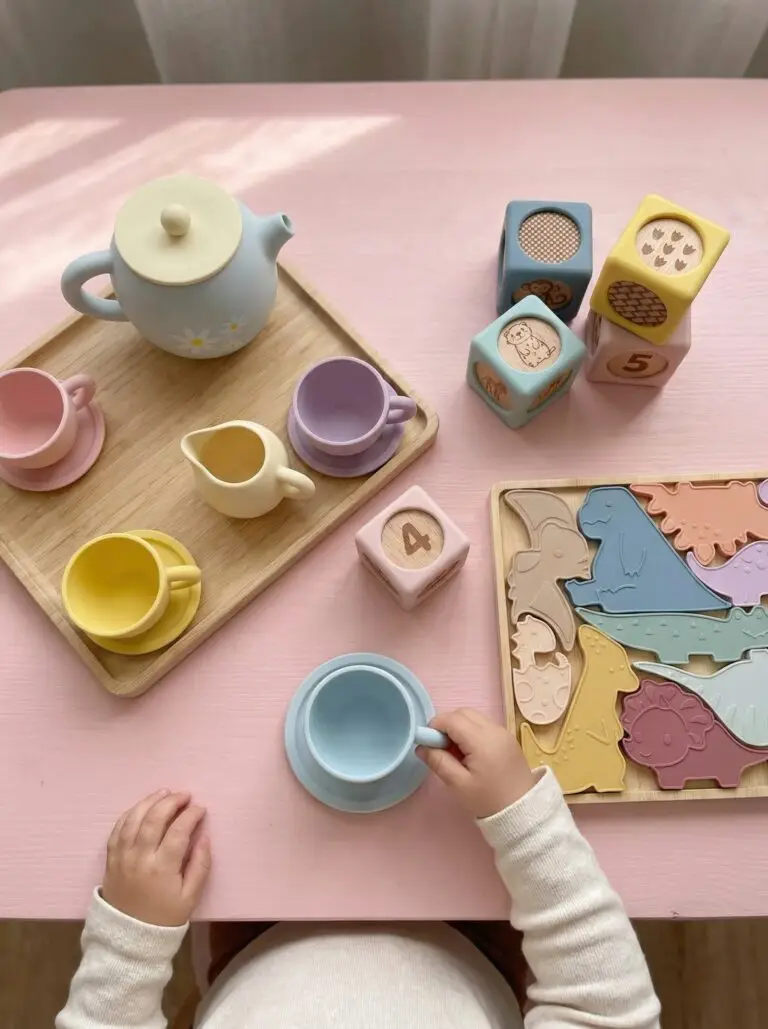
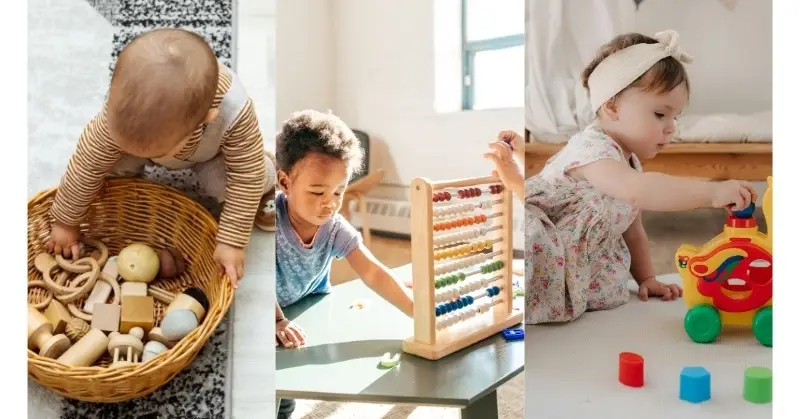
The research is clear that children this young learn best from real-world exploration, hands-on play, and face-to-face interaction with caring adults. Screens can’t replace those experiences, and shouldn’t try to. (Check out some of my favorite playtime items for 0-2 year olds: Screen Time Free Favorites)
But research also shows that when screen time does happen, quality matters enormously. High-quality programming viewed together with an adult who helps explain what’s happening can be a different experience than plopping a baby in front of fast-paced, overstimulating content alone.
What Makes a Show Appropriate for This Age?
The best shows for babies and young toddlers share these characteristics:
- Slow pacing with minimal scene changes
- Muted, soft color palettes rather than bright neon
- Gentle, calm voices that speak at a natural pace
- Simple storylines with clear beginnings, middles, and ends
- Repetition and predictability that help little ones feel secure
- Content that invites interaction, even if your baby can’t respond yet
Most importantly: shows that don’t leave your child in a trance or trigger meltdowns when you turn them off.
The Ultimate Calm: Low-Stimulation Shows That Create Peaceful Moments
Trash Truck (Netflix)
This sweet show about a trash truck and his best friend Hank (a young boy) has developed a serious cult following among parents of toddlers, and for good reason.
Why parents love it:
The pace is very gentle. Each episode follows simple adventures, Hank and Trash Truck collecting recycling, visiting Grandma, or having a sleepover. The animation style is soft and appealing without being overstimulating. And that signature “honk honk” has become iconic in many households.
Most importantly, parents consistently report that their children don’t have meltdowns when Trash Truck ends. The show seems to maintain engagement without creating that addictive “I need more NOW” response that plagues so many modern programs.
The only downside? There are only two seasons, and parents everywhere are hoping for more episodes.
This is my daughter’s favorite. On her second birthday our sweet friends gifted her a Trash Truck plush toy and board book. She still sleeps with the stuffed truck every night. She loves running outside when she hears our neighborhood trash truck coming so she can wave to her friend!
Where to watch: Netflix (including a Christmas special that works year-round)
Real parent wisdom: “My kid doesn’t scream when I turn off Trash Truck. That alone makes it worth it.”
Little Bear (Paramount+/YouTube)
If I could only recommend one show for this age group, it would be Little Bear. At 2.5 our little one still loves it. She is able to play with it on in the background and turns it off herself. Plus its nostalgic for mama!
This gentle Canadian series from the 1990s features watercolor animation that looks like a storybook coming to life. Little Bear and his woodland friends, Duck, Owl, Hen, and Cat, go on simple adventures that unfold at a leisurely pace. The music is extraordinarily soothing, and the voice work is calm and measured. Although you have to deal with watching in full screen, not wide screen, its worth it.
Why parents love it:
Multiple parents describe Little Bear as “so calming it puts me to sleep”, and they mean that as a compliment. One parent shared that it’s become their go-to for naptime routines because the muted colors and gentle pacing naturally help their toddler wind down. Another mentioned using it specifically for evening viewing because the soft animation creates a peaceful transition to bedtime.
The show teaches gentle values, friendship, imagination, problem-solving without any of the sass or behavioral issues that pop up in more modern programming. Nobody tricks anyone, excludes anyone, or models the kind of whining that you definitely don’t want your toddler imitating.
Where to watch: Full episodes are available on YouTube, making this an accessible without paying for subscriptions. It’s also on Paramount+.
Real parent wisdom: “I love Little Bear because itʼs so wholesome it puts me to sleep, but in the best way. The colors are muted, the voices are calm, and my daughter actually plays with her toys while it’s on instead of going into zombie mode.”
Puffin Rock (Netflix)
Set on a beautiful Irish island, Puffin Rock follows Oona the puffin and her little brother Baba as they explore their coastal home. Narrated by Chris O’Dowd (the Irish actor and comedian), the show features stunning animation and an incredibly soothing color palette.
Why parents love it:
Parents specifically mention the calming color palette as perfect for evening wind-downs. The Irish accents are unexpectedly soothing, and the pacing is slow enough that even very young toddlers can follow along. The show has natural “goodbye” moments at the end of each episode that help with transitions, a.k.a. no sudden endings that leave kids confused or upset.
Personally, I think the opening song is so peaceful and I used to love puffin’s growing up so watching with my little girl always brings a smile to my face. And, the nature content is wonderful and educational without being preachy.
Where to watch: Netflix
Real parent wisdom: “People should talk about Puffin Rock as much as Bluey. It’s that good, and so much calmer for this age.”
The Classics That Still Work
Mr. Rogers’ Neighborhood (PBS/Amazon Prime)
Fred Rogers remains the gold standard for gentle, intentional children’s programming. His direct address to the camera, slow pacing, and genuine warmth create an experience unlike anything in modern television.
Why parents love it:
Mr. Rogers speaks to children at a natural pace, treating them with respect and honesty. There are no flashy graphics, no rapid scene changes, no attempts to grab and hold attention through stimulation. Just a kind man talking about feelings, visiting interesting places, and showing children that they matter.
Research has shown that well-designed programs like Mr. Rogers can actually support emotional development in young children, especially when watched with a caring adult who helps connect what’s happening on screen to real life.
Where to watch: PBS offers 5 free episodes every two weeks on their website (MrRogers.org). Full episodes are also available on Amazon Prime.
Pro tip: Stick to the original series from the 70s-90s. The pacing and content from that era feels more appropriate for very young children than some of the later iterations.
Bear in the Big Blue House (Disney+)
Another nostalgic favorite from the late 90s/early 2000s, this show features a giant bear (in a full costume, not animation) who lives in a big blue house with his mouse friend Tutter and other characters.
Why parents love it:
The show has a predictable structure that helps young children feel secure. Bear always does his “sniffy song,” there are clear routines, and the goodbye song at the end provides closure. The full-costume characters move more slowly than animation, which naturally creates a calmer viewing experience.
Many millennial parents remember this show from their own childhoods, which adds a layer of comfort and nostalgia to watching it with their own children.
Where to watch: Disney+
Real parent wisdom: “That goodbye song hits different when you’re a parent. My son loves when Bear ‘sniffs’ us after the show ends.”
Classic Thomas the Tank Engine (Amazon Prime Video/YouTube)
Here’s one I get asked about, and it absolutely belongs on this list. The original Thomas & Friends, the classic version from before the switch to CGI, is one of the best examples of accidental low stimulation. Those episodes were filmed with real model trains, so everything moves at the pace of little toys being nudged along a track.
Why parents love it:
The pacing is slow, with long, steady shots of engines rolling through the countryside. The narrator is calm and unhurried, the music is simple, and every episode is short with a clear beginning, middle, and end. That tidy ending makes it easy to turn off, so it tends to pass the “turn off test” without a meltdown. It’s also a great fit for toddlers who are train obsessed, and a lot of them are.
The honest truth:
Stick to the classic episodes. The newer CGI seasons are faster, louder, and full of quick cuts, so they don’t fit the low stim mold. The classic engines can also be a little cheeky, and Sir Topham Hatt does scold them now and then, so watch with your little one and talk through it.
Where to watch: Amazon Prime Video, and the official Thomas & Friends YouTube channel has some classic episodes too
The “Not Technically for Toddlers But It Works” Category
Bob Ross: The Joy of Painting (YouTube/PBS)
Yes, I’m serious. Multiple parents swear by Bob Ross for creating calm, independent play time for their babies and toddlers.
Why it works:
Bob Ross’s voice is extraordinarily soothing. The pace is meditative. The content is genuinely beautiful, watching trees and mountains appear on canvas holds attention without overstimulating. And because there’s no plot, there’s no “I want to see what happens next!” hook that creates those post-show meltdowns.
Parents report using Bob Ross as background “noise” while their little ones play independently. It seems to create a peaceful atmosphere that actually encourages exploration rather than screen fixation.
Where to watch: Free on YouTube, also on PBS
Real parent wisdom: “I used to watch Bob Ross with my boys to wind down before bed when they were little. We’d all cuddle up and watch him paint. Those ‘happy little trees’ became part of our family vocabulary.”
Nature Content & Virtual Experiences
Sometimes the best “show” isn’t a show at all. Many parents have found that their babies and toddlers are genuinely engaged by:
Virtual aquariums (especially Aqualio on YouTube) — The slow-moving fish and gentle bubbling sounds create a calming sensory experience.
Bird feeder cameras — Real birds visiting feeders in real-time. No narration, no music, just nature happening.
Classical music with simple visuals — Yo-Yo Ma playing cello in the woods, or other baroque soloists in beautiful settings.
Virtual city tours — Slow walks through Japanese towns or watching Istanbul street cats. The steady camera movement and real-world sounds provide gentle stimulation.
Real parent wisdom: “We watch virtual aquariums and my 14-month-old will play for a very, very long time with this on in the background. It’s like having a peaceful fish tank without the maintenance.”
Special Situations: Using Low-Stimulation Shows Strategically
For Absolutely-Must-Sit-Still Moments
Some parents use shows strategically for situations where keeping a toddler calm and still is essential. As a mom to a toddler with curly biracial hair that requires daily maintenance . . . sometimes a screen is the only way to get her to sit long enough for me to give her curls what they need.
Nail trimming and haircuts: Several parents mentioned using very short amounts of Ms. Rachel (despite finding it generally too stimulating) specifically for these challenging moments. “My baby watches Ms. Rachel when we cut his nails and his hair, max a couple of minutes every 2-3 weeks. It’s the only thing that keeps him perfectly still, and I figure that’s better than stabbing him in the eye.”
Medical appointments or procedures: Having a familiar, calming show available can make necessary situations less stressful.
The key is limiting these uses to truly necessary moments rather than making them part of daily routines.
What to Avoid for This Age Group
Based on both research and parent experiences, these red flags suggest a show is too stimulating for babies and young toddlers:
Ms. Rachel: While educational and helpful for speech development, many parents report an almost concerning level of obsession. Multiple parents describe limiting Ms. Rachel to very specific, brief uses rather than regular viewing.
Cocomelon: Nearly universally avoided by parents seeking low-stimulation content. “Mind-numbing cult show” was one description. The rapid scene changes and bright colors seem designed to be addictive rather than educational.
Modern Sesame Street: While classic Sesame Street (1990s-2010) gets praise, the newer versions have gotten significantly faster-paced and more animated. Parents who tried recent seasons found them “basically unwatchable” compared to older episodes.
Practical Viewing Tips for This Age
Co-Viewing Makes All the Difference
Research shows that babies and toddlers under 2 can learn from high-quality educational media, but only when a caregiver participates and helps connect what’s happening on screen to real life.
This might look like:
- Pointing at and naming objects on screen
- Making connections: “See the bird? Like the birds in our backyard!”
- Singing along with songs
- Asking simple questions: “Where’s the duck?”
You don’t need to provide constant narration, but your presence and occasional interaction transforms passive viewing into a shared experience.
Keep It Short
Even with the gentlest content, 15-20 minutes is plenty for this age group. Multiple short sessions spread throughout the day (if needed) are better than one long viewing session.
Use the “Turn-Off Test”
The best indicator of whether a show is truly low-stimulation: Can your child transition away from it without a meltdown?
Shows like Little Bear, Trash Truck, and Puffin Rock consistently pass this test. If your child regularly screams when a particular show ends, that’s a sign it might be too stimulating, even if it seems “gentle” on the surface.
Looking for Something for an Older Sibling?
If you have a preschooler (ages 2-4) who needs their own programming while you’re tending to the baby, my guide, The Best Calm Shows for Preschoolers (Ages 2-4), is ready for you. I cover shows like Daniel Tiger, Bluey, and other programs that support emotional development without overstimulating young minds.
For kindergarten and early elementary ages (5+), the Educational Shows That Don’t Feel Like School guide will feature programs that spark curiosity about science, nature, and the world while maintaining that important gentle pace. Again, join the email list to get notified when it’s published!
The Bottom Line for Low-Stimulation Shows
Perfect screen-free parenting might not be the goal, or frankly, realistic for most families. The goal can be finding shows that support your child’s development (or at least don’t undermine it) during those moments when you genuinely need the assist.
The shows in this guide won’t turn your baby’s brain to mush. They won’t create that concerning “trance state.” They won’t lead to epic meltdowns when it’s time to turn off the TV.
What they will do is give you those precious fifteen minutes to dry your hair, make breakfast, or simply sit down with your coffee while it’s still warm. And sometimes, that’s exactly what parenting looks like.