The tantrum came out of nowhere. One minute my daughter was playing happily with her blocks, the next she was face-down on the floor screaming because her tower fell over. Again. Welcome to the preschool years, where big feelings arrive in tiny bodies with zero warning and even less ability to regulate them and moms everywhere search for the best calm shows for preschoolers without overstimulation. If you haven’t read my Guide to Low Stimulation Shows, start there before continuing.
This is the age when kids are learning to navigate friendship, disappointment, sharing, patience, and all those other emotional skills that adults still struggle with. Their brains are developing the capacity for empathy and self-regulation, but they need support. A lot of support.
And here’s something I’ve learned from both my sister (a Social Psychologist and Teaching Associate Professor at the University of Colorado) and from living through these the start of these years myself: The right calm shows for preschoolers and toddlers can actually help with this developmental work.
I’m not saying TV teaches emotional regulation better than real-life experience, it doesn’t. But a well-designed show watched together can give your child language for their feelings, model problem-solving strategies, and create shared reference points for those teachable moments. (“Remember how Daniel Tiger felt frustrated? What did he do?”)
This guide focuses on calm shows for preschoolers and toddlers specifically designed to support emotional learning. These are programs that teach feelings, friendship, and problem-solving without the overstimulation that makes everything worse. These are shows that help rather than hype, calm rather than create chaos.
Because raising a tiny human through the emotional rollercoaster years is hard enough without adding post-screen meltdowns to the mix.
If you’d like a printable screen-free activity, snag our fall preschool worksheets.
- Why the Right Shows Matter at This Age
- The Gold Standard: Shows That Actually Teach
- The Gentlest Options: Maximum Calm with these Calm Shows for Preschoolers
- Classic Favorites That Still Deliver Calm Shows for Preschoolers
- Shows to Approach Thoughtfully
- Learning-Focused Calm Shows
- What to Avoid (Not so Calm Shows for Preschoolers)
- How to Get the Most from Calm Preschool Shows
- Looking for Something for a Different Age?
Why the Right Shows Matter at This Age
Between ages 2 and 4, children’s brains are experiencing explosive growth in areas related to emotional regulation, empathy, and social understanding. They’re learning to:
- Identify and name their own emotions
- Recognize feelings in others
- Manage disappointment and frustration
- Share and take turns
- Solve conflicts with peers
- Develop patience and self-control
This is hard work. Really hard work. And it doesn’t happen overnight.
The best calm preschool shows act like gentle coaches, modeling strategies, providing language, and normalizing the struggle. They show characters experiencing the same big feelings your child has, then demonstrate age-appropriate ways to handle them.
What Makes a Show “Calm” for Preschoolers?
Not all educational content is created equal. The best shows for preschoolers in this age range share these characteristics:
- Relatable conflicts that mirror real preschool struggles (sharing toys, feeling left out, managing frustration)
- Clear problem-solving that shows the process, not just the solution
- Emotional vocabulary that gives kids words for their feelings
- Realistic pacing that allows time to process what’s happening
- Repetition and reinforcement through songs, catchphrases, or routines
- Calm resolution that doesn’t over-dramatize or reward poor behavior
Most importantly: shows that support emotional development without creating the overstimulation that undermines it.
The Gold Standard: Shows That Actually Teach
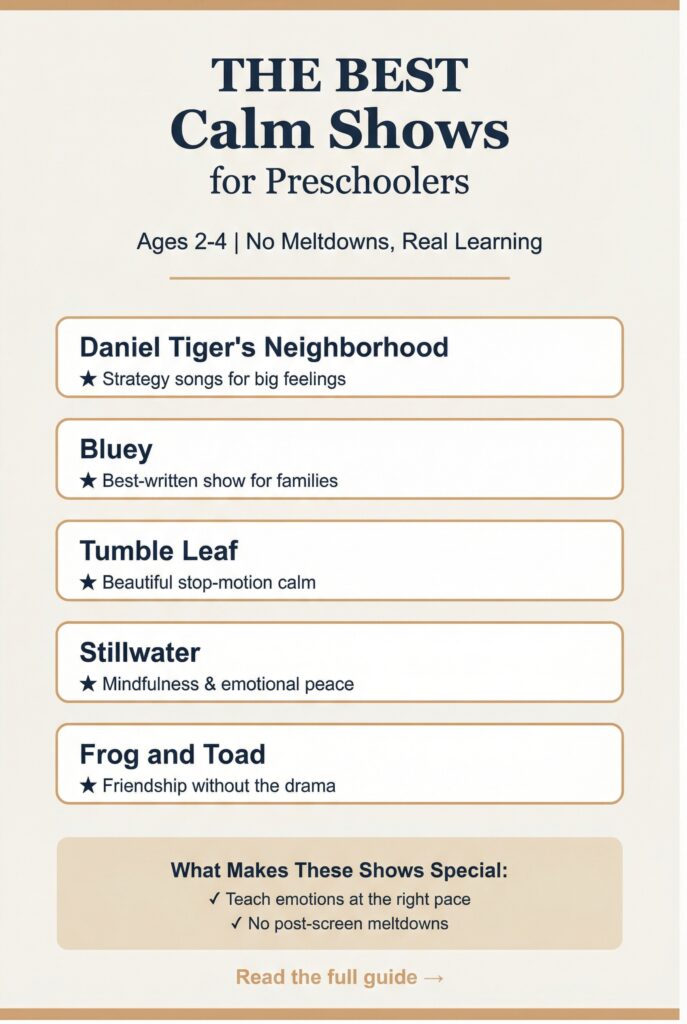
Daniel Tiger’s Neighborhood (PBS Kids)
If there’s one show that dominates parent conversations about emotional learning, it’s Daniel Tiger. And for good reason.
This animated successor to Mr. Rogers’ Neighborhood follows Daniel Tiger (son of the original Daniel from the Neighborhood of Make-Believe) and his friends as they navigate typical preschool challenges: waiting for their turn, managing anger, dealing with disappointment, trying new foods, and more.
Why it’s one of the best calm shows for preschoolers:
The “strategy songs” are genuinely brilliant. Short, catchy jingles that give kids concrete tools.
- “When you feel so mad that you want to roar, take a deep breath and count to four”
- “When something seems bad, turn it around and find something good”
- “It’s okay to feel sad sometimes. Little by little, you’ll feel better again”
These aren’t just cute rhymes, they’re actual emotional regulation strategies set to music that kids can remember and use in real situations. Multiple parents report their toddlers spontaneously singing these songs to themselves during challenging moments. My daughter also sings them in the car, in her bed, and while watching!
The show maintains Mr. Rogers’ gentle pacing and direct address to viewers. Daniel looks at the camera and asks children questions, creating space for them to think and respond (even if just in their heads). This is one of our favorite calm shows for preschoolers.
The honest truth:
Not every parent loves Daniel Tiger. Some find the songs repetitive or Daniel himself occasionally whiny. One parent noted, “There are shows that I like to watch with her and Daniel isn’t one of them.” But even those parents acknowledge that it works, their kids learn the strategies and use them. This one is a go-to for our family.
Where to watch: PBS Kids app (free), Amazon Prime, PBS.org
Pro tip: Watch episodes that address whatever your child is currently struggling with. Potty training episode before starting potty training. Bedtime episode when bedtime battles intensify. The show is incredibly well-organized by topic. We loved the winter episode and understanding weather appropriate clothing!
Bluey (Disney+)
Here’s where I’m going to be honest: Bluey is technically more stimulating than most calm preschool shows in this guide. The pacing is faster, the music is constant, and there’s a lot happening on screen.
But it’s also possibly the best-written children’s show ever created. (Seriously, I have found both my husband and myself watching without our toddler).
This Australian series follows Bluey (a Blue Heeler puppy) and her family as they navigate everyday life through imaginative play. The emotional intelligence, family dynamics, and problem-solving are extraordinarily well-done.
Why parents love it:
The play-based learning is incredible. Bluey and her sister Bingo work through real feelings and conflicts through imaginative games that parents can actually replicate at home. The show models healthy family relationships, including parents who make mistakes and repair them.
Many episodes will make you cry. Not your kids, you. Episodes like “Sleepytime” and “Baby Race” hit different when you’re in the parenting trenches yourself. Me watching these episodes a few weeks postpartum . . . puddle of tears! So many parents say this is their favorite calm shows for preschoolers.
The important caveat:
Multiple parents mentioned limiting Bluey to 2-3 episodes at a time because the background music and pacing can be overwhelming, especially for sensitive kids. One parent noted: “There’s so much music and beat in the background, it’s hard even for me to understand what they’re saying.”
For some children, Bluey before bed creates more chaos than calm. Know your kid and adjust accordingly.
Where to watch: Disney+
Real parent wisdom: “Bluey is fantastic for teaching empathy and problem-solving, but we had to make a ‘not after 5 PM’ rule because it winds her up too much.”
Tumble Leaf (Amazon Prime Video)
This gorgeous stop-motion series follows Fig the fox as he explores the island of Tumble Leaf with his caterpillar friend Stick. Each episode centers on gentle scientific discovery and problem-solving through observation and experimentation.
Why it’s perfect for calm preschool viewing:
The stop-motion animation creates naturally slower pacing. You literally can’t rush stop-motion the way you can digital animation. The show is calm, beautiful, and genuinely educational without being preachy.
Fig models curiosity, patience, and the scientific method in age-appropriate ways. He wonders, observes, tries things, makes mistakes, and figures things out. The emotional tone is consistently peaceful and encouraging.
The “Finding Place” phenomenon:
Multiple parents report that “The Finding Place” (Fig’s special spot where he discovers interesting objects) has become part of their family vocabulary. Kids create their own “finding places” and approach problems with Fig’s gentle curiosity.
Where to watch: Amazon Prime Video
Real parent wisdom: “Tumble Leaf is like a warm hug. Fig never gets frustrated or gives up, and my son has started saying ‘let me think about this’ instead of immediately melting down.”
The Gentlest Options: Maximum Calm with these Calm Shows for Preschoolers
Guess How Much I Love You (Amazon/Peacock)
Based on the beloved books, this series features Little Nutbrown Hare and his father exploring the meadow and learning about the world together. The watercolor animation is absolutely beautiful, and the emotional core, unconditional love, resonates deeply.
Why it works:
The show models a secure parent-child relationship where curiosity is encouraged, mistakes are learning opportunities, and big feelings are met with patience. The pacing is extraordinarily slow and the visual style is soothing.
Several parents mentioned getting emotional themselves while watching—the relationship between Little Nutbrown Hare and Big Nutbrown Hare captures something tender about parenting that hits hard when you’re in it.
Where to watch: Amazon Prime Video, Peacock
Real parent wisdom: “This is the most calming preschool show we’ve found. The watercolor animation alone is worth it.”
Frog and Toad (Apple TV+)
This Apple TV+ adaptation of Arnold Lobel’s classic books is a masterclass in friendship and emotional honesty. Frog and Toad are best friends with very different personalities who navigate misunderstandings, disappointments, and everyday adventures together.
Why it’s one of the best calm shows for preschoolers:
The friendship dynamics are incredibly realistic—including moments of frustration, miscommunication, and repair. The show doesn’t shy away from uncomfortable feelings but handles them with gentleness and humor.
The animation is beautiful and minimal. The pacing is slow. The lessons about friendship, loyalty, and accepting differences feel authentic rather than preachy.
Where to watch: Apple TV+
Real parent wisdom: “Frog and Toad helped my daughter understand that friends can have disagreements and still be friends. That was huge for her preschool social life.”
Stillwater (Apple TV+)
If you want to introduce mindfulness concepts to your preschooler, Stillwater is the show. Based on Jon J. Muth’s Zen stories, it follows three siblings and their friend Stillwater—a giant panda who helps them navigate challenges through gentle wisdom and mindfulness practices.
Why it works:
This is possibly the calmest show on television. The animation is soft, the pacing is meditative, and the lessons about being present, managing big feelings, and finding peace are conveyed through stories rather than lectures.
Each episode includes a “stillness” moment where characters (and viewers) practice breathing, observation, or other mindfulness techniques. It’s genuinely zen.
Where to watch: Apple TV+
Real parent wisdom: “Stillwater is our bedtime show. It’s so peaceful that we all calm down watching it together.”
Classic Favorites That Still Deliver Calm Shows for Preschoolers
Franklin the Turtle (YouTube/Kanopy)
This Canadian series from the late 90s/early 2000s follows Franklin and his animal friends as they navigate typical childhood challenges: fear of the dark, learning new skills, handling disappointment, making friends.
- Why it’s a solid calm option for preschoolers: The pacing is slow by modern standards, and the problems are relatable. Franklin deals with anxiety, frustration, jealousy, and other real emotions in age-appropriate ways.
- The honest truth: Franklin causes some discussion and disagreement. Some parents find him whiny or the lessons too heavy-handed. Others appreciate the straightforward approach to emotional challenges. Your mileage may vary.
- Where to watch: YouTube (full episodes), Kanopy (through many public libraries)
Max and Ruby (YouTube)
This series about two rabbit siblings, responsible older sister Ruby and mischievous younger brother Max—shows sibling dynamics in action.
- The controversy: Max and Ruby generates strong opinions. Some parents love the gentle humor and sibling problem-solving. Others hate that the parents are never shown and feel Ruby is too bossy while Max is rewarded for not listening. The show is undeniably calm and slow-paced, which is why it makes this list. But whether it’s teaching the right lessons is up for debate.
- Real parent wisdom: “I can’t stand Max and Ruby because of the sibling dynamics, but my kids watched it and turned out fine. Sometimes you just need something calm on, and it definitely qualifies.”
- Where to watch: YouTube
Shows to Approach Thoughtfully
Sesame Street (PBS Kids)
The classic approach: Stick to episodes from the 1990s-2010 era for the best balance of educational content and calm pacing.
Why the older episodes work better:
Pre-2010s Sesame Street featured longer segments, slower pacing, and more focus on emotional storylines. The newer episodes have gotten faster and more Elmo-centric, with shorter attention spans and more rapid scene changes.
One parent captured it perfectly: “By the time iPad babies started existing, Sesame Street realized attention spans were shot, so they sped everything up.”
If you can find the older episodes (some are on YouTube, others on HBO Max), they offer solid emotional content. The newer ones? They’re less calm than they used to be.
Where to watch: PBS Kids (current episodes), HBO Max (broader library), YouTube (vintage episodes)
Peppa Pig (Various platforms)
Peppa is undeniably low-stimulation from a visual and pacing perspective. The simple animation and gentle British accents create a calm viewing experience.
The concerns:
Peppa can be sassy, occasionally rude to her father, and models some behaviors you might not want reinforced (calling Daddy Pig fat, being bossy with friends). Some parents love it anyway. Others ban it.
The show does address friendship conflicts, family dynamics, and everyday emotional challenges, just not always in ways that align with every parenting philosophy.
Where to watch: Paramount+, YouTube
Real parent wisdom: “Peppa is calm and my kid loves it, but I had to have a talk about ‘Daddy’s big tummy’ because that body-shaming stuff is not okay in our house.”
Learning-Focused Calm Shows
For Number and Letter Learning
Numberblocks (Netflix)
While primarily focused on math concepts, Numberblocks characters have distinct personalities and navigate friendship challenges. The 5-minute episode length prevents overstimulation, and the problem-solving approach is gentle and encouraging. This show has helped our little one count and hopefully soon will help with math skills!
Episodes are short enough to watch 2-3 in a row without overwhelming kids. Multiple parents report major learning leaps from this show.
Also worth trying: Alphablocks (letters) and Colourblocks (colors/emotions)
Where to watch: Netflix
For Vehicle-Obsessed Kids
Stinky and Dirty (Amazon Prime Video)
This series follows a garbage truck (Stinky) and a backhoe (Dirty) as they solve problems together through trial and error. The problem-solving is excellent, and the friendship between the two main characters models healthy relationship dynamics.
The animation style is simple and the pacing is calm. The show emphasizes persistence, creative thinking, and asking for help—all valuable emotional skills wrapped in vehicle content.
Where to watch: Amazon Prime Video
Classic Thomas the Tank Engine (Amazon Prime Video/YouTube)
If your preschooler loves anything on wheels, the original stop-motion Thomas is a calm option. The pacing is slow, the stories are simple, and each episode wraps up neatly. Just stick to the classic episodes, because the newer CGI seasons are much faster. I break down why in my Guide to Ages 0-2.
Where to watch: Amazon Prime Video, and some classic episodes on the official Thomas & Friends YouTube channel
What to Avoid (Not so Calm Shows for Preschoolers)
Caillou (Mostly unavailable now, but worth mentioning)
If you encounter Caillou in the wild, run. The titular character is famously whiny, throws tantrums that are rewarded, and models pretty much every behavior you’re trying to discourage.
Parents across the internet have banned Caillou for good reason. One parent summed it up: “Caillou teaches kids that whining gets you what you want. Hard pass.”
Modern Blues Clues (Paramount+)
While original Blues Clues with Steve (or even Joe) was gentle and educational, some parents feel the newer version with Josh has gotten overstimulating. One parent described it as “Blue went to Cocomelon land.”
If your child loves Blues Clues, try to find the original episodes with Steve from the late 90s/early 2000s.
How to Get the Most from Calm Preschool Shows
Co-Viewing Makes the Difference
Research shows that preschoolers learn emotional concepts from media most effectively when adults watch with them and help make connections:
During the show:
- Point out emotions: “Look, Daniel is feeling frustrated. See his face?”
- Predict outcomes: “What do you think Bluey will do?”
- Connect to real life: “Remember when you felt that way?”
After the show:
- Reference strategies: “Want to try Daniel’s deep breathing?”
- Process the story: “Why was Fig confused? How did he figure it out?”
- Apply the lesson: “That’s like when you and your friend had to share yesterday!”
You don’t need to narrate constantly, just a few strategic comments make a big difference with these calm shows for preschoolers.
Use Songs as Real-Life Tools
Those Daniel Tiger strategy songs work because they’re memorable and portable. When your child is actually mad, singing “When you feel so mad that you want to roar, take a deep breath and count to four” gives them a concrete tool.
Many parents keep a mental list of relevant songs for different situations:
- Frustration: The “mad that you want to roar” song
- Disappointment: “When something seems bad, turn it around”
- Sadness: “It’s okay to feel sad sometimes”
- Waiting: “Waiting can be hard, but it can be worth it”
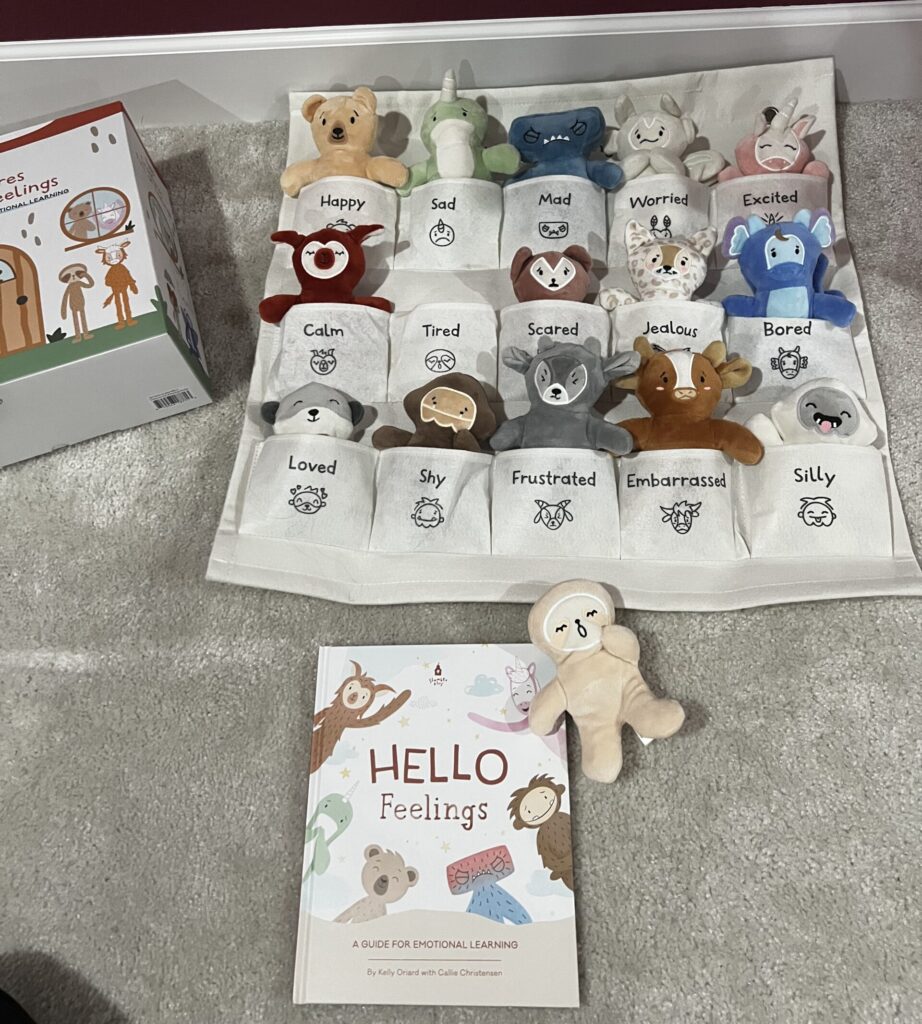
Beyond Screen Time: Hands-On Tools for Big Feelings
While calm shows for preschoolers like Daniel Tiger provide excellent modeling for emotions, sometimes kids need something tangible. The Slumberkins Creatures Full of Feelings Toolkit has become essential in our house for exactly this reason.
Created by therapists, it includes 15 adorable creatures that each represent a different emotions. My daughter now grabs it when she’s starting to feel overwhelmed and points to the creature that matches her feeling (usually ‘tired’).
Full transparency: This is an affiliate link, meaning I earn a small commission if you purchase through it—at no extra cost to you!
Match Shows to Current Challenges
If your child is struggling with sharing, watch the Daniel Tiger sharing episode. Starting preschool? Find the “first day of school” episodes across different shows.
This targeted approach helps kids see their challenges reflected on screen and gives you shared language to discuss the issue together.
Set Time Limits That Work
Even the best calm shows for preschoolers benefit from limits. Many parents find that 2-3 episodes (20-30 minutes) is the sweet spot for this age range—enough time to engage and learn, not so much that overstimulation sets in.
Looking for Something for a Different Age?
Have a baby or younger toddler (ages 0-2)? Check out our guide to The Gentlest First Shows for Ages 0-2, featuring ultra-calm options like Little Bear, Puffin Rock, and even Bob Ross for creating peaceful moments with your littlest ones.
Ready for more advanced content (ages 5+)? Our Educational Shows That Don’t Feel Like School for Ages 5+ guide is coming soon and will cover programs that spark curiosity about science, nature, and the world while supporting continued emotional development.
The Bottom Line
The years between 2 and 4 are emotionally intense (for kids and parents alike). Finding calm shows for preschoolers that support your child’s developing emotional intelligence without adding to the chaos isn’t just nice to have. It’s survival.
The shows in this guide won’t magically eliminate tantrums or turn your toddler into an emotionally regulated zen master. But they can provide language, strategies, and modeling that genuinely helps during this developmentally wild time.
And when you hear your three-year-old spontaneously singing “take a deep breath and count to four” during a frustrating moment? That’s not just cute. That’s brain development in action.
Your turn: Which calm preschool shows have helped your child navigate big feelings? Have you noticed your child using strategies or language from specific episodes? Share your experiences in the comments, we’re all learning together!
Looking for more slow parenting resources? Read our complete Ultimate Guide to Low-Stimulation Shows for the philosophy behind these recommendations and tips for evaluating any show your child encounters.