If you’re reading this from the other side of potty training, I see you. And if you’re about to start, here’s what I wish someone had told me: potty training a toddler is exactly as hard as everyone says. You will absolutely get through it. We started at 29 months, blocked off a four-day weekend, and survived, barely, but we did. This is our honest story on how to potty train a toddler.
My husband and I had listened to the Oh Crap! Potty Training audiobook by Jamie Glowacki (it’s short, it’s practical, skip around if you need to), and I felt about as ready as you can feel before something completely humbles you. We blocked off four days, stayed home, and went all in. No big plans, no real distractions, just us, our toddler, and a whole lot of paper towels.
This is our honest story, day by day, with the things that actually worked and the things that did not.
- How to Potty Train a Toddler: Start with the Right Mindset
- Day One: Buckle Up
- Day Two: The Opinions Arrive on How to Potty Train a Toddler
- The Hardest Day: Day Three
- Day Four: My Husband Travels, I Hold the Fort to Potty Train a Toddler
- Day Five: Back to School
- What Actually Worked When We Potty Trained Our Toddler
- A Few Weeks Later
- Potty Train a Toddler FAQ
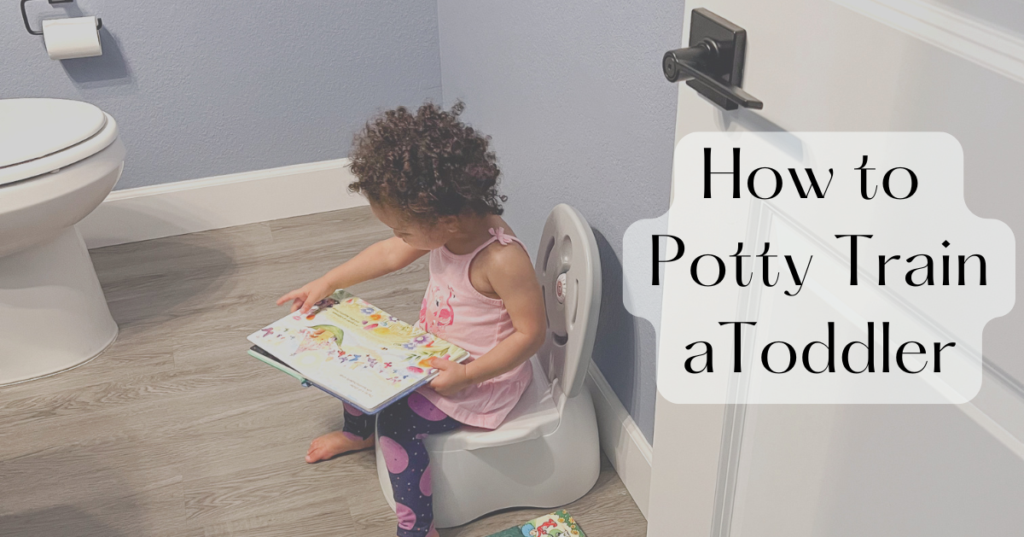
How to Potty Train a Toddler: Start with the Right Mindset
Before I get into our week, I want to share the biggest mindset shift the book gave me, because it genuinely changed how I approached the whole thing.
Every kid is different, and there is no one-size-fits-all method. The book walks you through the progression from naked, to bare bottom, to commando, to underwear. It gives you permission to follow your kid’s lead the whole way. It also takes a pretty strong stance on not bribing with rewards, which we tried to honor (more on how that went in a minute).
One thing Jamie is clear about: you need to block off real, dedicated time. No big outings, minimal distractions, eyes on your kid. That felt extreme to me before we started. By day two, I completely understood why.
Naked vs. Clothing: What Actually Worked to Potty Train a Toddler
I also want to be honest that lots of people recommended starting with a fully naked baby. While she made it through day one, my daughter wanted absolutely nothing to do with that after. She screamed for her diaper the moment we took it off on day two, and we compromised with just a shirt on, nothing on the bottom.
She hated being naked, so we adapted. The book actually prepares you for this, every kid is different, and listening to your child matters more than following the method perfectly.
Floor Potty vs. Toilet Seat: Which One We Chose
You’ll also hear a lot of people recommend a training seat that sits directly on the full size toilet, and that is a totally valid option. We chose a standalone floor potty instead, because I could move it from room to room and keep it wherever she was.
The tradeoff is real: we dumped the contents into the toilet every single time, and yes, we had to retrain her for the full size toilet eventually. But for us, having the potty right there in whatever room we were in made a big difference in those early days when every second counted. School’s full size toilet actually helped her make that transition naturally, so it worked out just fine.
If you’re a reader who loves a good mom-recommended book list, here are my top three pregnancy and motherhood reads too (I need to add Jamie’s book to the list!). My Top 3 Pregnancy and Motherhood Books Blog
Day One: Buckle Up
We started on a Friday morning. No bottoms, potty in the living room, eyes on her at all times. While I took the day off work, my husband was home too and we tag-teamed it so neither of us lost our minds completely.
Here is what day one actually looked like, straight from the notes I kept on my phone:
- 8:00am, peed on the floor
- 8:45am, peed on the floor
- 9:45am, peed on the floor
- 10:20am, pee on the pink kids chair while eating
- 10:40am, kitchen tower peed
- 10:47am, peed on the floor at the coloring table
And then, at 10:50am, she made it to the potty.
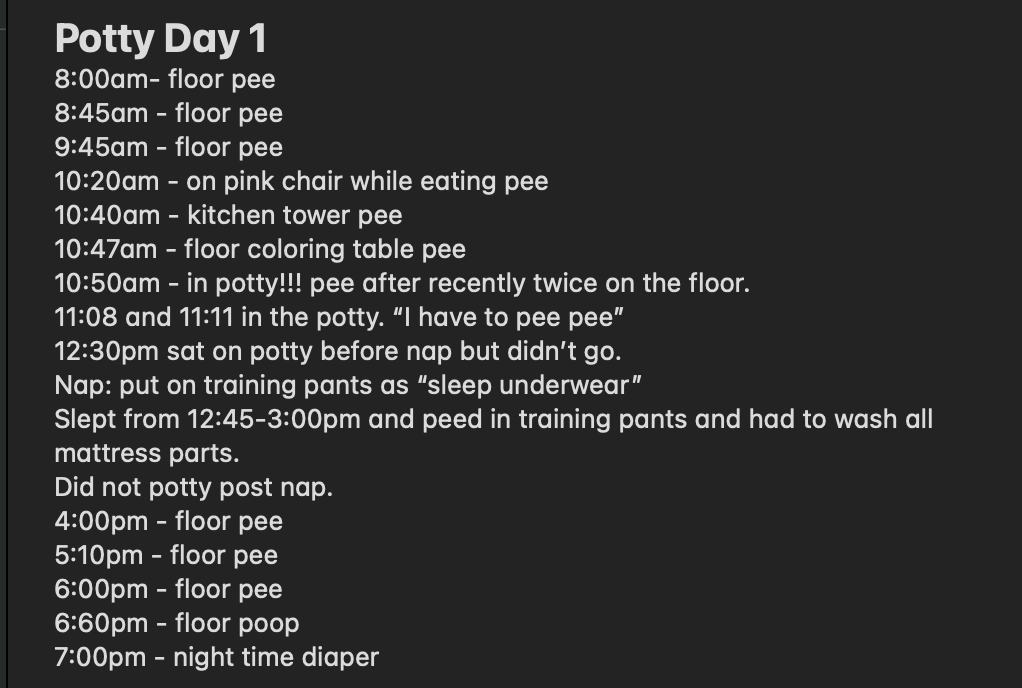
I cannot tell you the amount of celebrating that happened in our house at 10:50am on a Friday morning. By 11:08 and 11:11, she was telling us “I have to pee pee” and going on her own. We did a full pee pee dance every single time (you know the song and dance from the 1990 comedy movie Look Who’s Talking Too? “pee pee in the potty, pee pee in the potty”). It sounds ridiculous. It worked.
Nap Time Reality Check
One thing the Oh Crap! book gives you is a choice: you can tackle daytime and nighttime training together, or you can focus on daytime first and come back to nights later. We tried to do both at once on day one, and that was a mistake for us.
At nap time, we put her in cotton training pants as “sleep underwear,” which is a framing the book suggests to help kids understand the difference between sleep and wake time. I want to be clear that we used actual cotton training pants, not pull-ups, because pull-ups feel too much like a diaper and can confuse the process.
Well, she woke up wet and we washed every single mattress part. By bedtime we were exhausted and made the call to put her back in a nighttime diaper. We kept nap and nighttime in a diaper for weeks after, and honestly, that was the right call for our family. Daytime first, nights later.
Day one was a lot. I cried a lot and wine that night was earned.
Day Two: The Opinions Arrive on How to Potty Train a Toddler
Day two she woke up and while we tried to go naked again, she immediately screamed for her diaper back. We compromised with a shirt on and nothing on the bottom, which is actually where we stayed for most of the training. She hated being fully naked, and once we stopped fighting that battle, things got a little smoother.
The Morning
She sat on her floor potty twice that morning with nothing. Then around 10:00am we introduced what she called her ‘big potty,’ her travel potty seat on the full size toilet, paired with the familiar step stool she used for hand washing every day. She went pee, and immediately asked for a chocolate chip.
Two minutes later she asked to go again, didn’t go, and still asked for the chocolate chip. We had tried not to bribe, but in that first moment we gave in, and she caught on to the system fast. So we pulled back on the rewards, and honestly, she understood. When we explained she hadn’t gone, she’d nod, ask to flush, and wash her hands. The routine mattered to her just as much as anything else.
By 10:55am she squatted and told us she needed to poop. We got her to the big potty and she didn’t go, but the fact that she was communicating it felt like progress. While I was grabbing the potty, she peed on the steps at the sink. I cleaned it up, she climbed on the big potty while I did, and still nothing. That is just day two for you.
The Afternoon Shift
The afternoon was actually more encouraging. My husband caught her crossing her legs at 4:25pm and got her to the potty and she went. She was starting to show us her tell-tale sign. There was still a floor pee at 4:50pm, but we were seeing the pattern emerge.
Bedtime gave us one of the best moments of the whole weekend. She sat on the potty before bed by herself, I stepped away to clean up, and came back to the sound of her going on her own. I could have cried. An hour later, still wide awake, she called out saying “I poppy” and wanted to take her diaper off and try. Still, nothing came, but the fact that she was thinking about it at 8:00pm told me something was clicking.
The Hardest Day: Day Three
Day three was when I hit my wall.
She fought us more. The Paw Patrol underwear came out, which I had foolishly left where she could see it, and that became the whole mission. Putting them on herself was non-negotiable. She let dad help but told me to go away. There were floor pees and tears, and by 6:25pm I was the one crying and overwhelmed.
In my notes from that day I literally wrote: “mom is crying and overwhelmed.”
Three full days if staying home with minimal distractions is harder than it sounds. We kept the TV off, kept toys front and center, and kept our eyes on her constantly looking for her tell-tale sign. Hers was crossing her legs right before she needed to go, and once we spotted that, we could get her to the potty in time at least some of the time.
We also introduced a new potty style she could get on and off herself that day, which she loved climbing up and down from, even if she didn’t always go. Giving her some control helped.
Day three was the day I texted a mom friend who had already been through it, just to hear that it was supposed to feel this hard. It was.
Day Four: My Husband Travels, I Hold the Fort to Potty Train a Toddler
My husband flew out on day four. That left me solo, and I cried a little before he even made it out the door.
But something shifted that day. She started catching herself mid-pee and making it to the potty to finish. The connection between the feeling and the action was finally clicking. When my husband called from the airport and asked her to sit on the potty over the phone, she did it without hesitation. The potty was becoming normal.
By the end of day four, she was crossing her legs, getting herself to the potty, and finishing there. Still accidents. Still not consistent. But the light at the end of the tunnel was visible.
Day Five: Back to School
We sent her to school on day five in training pants and pants (her first time with something on the bottom during the day). I had a whole conversation with her teachers, who were kind and reassuring and said accidents on the first day back are completely normal. They had M&Ms on hand for kids who needed the nudge, and when I mentioned we were avoiding bribing, they got it completely.
She went potty once at school and had one accident. For day five, I’ll take it.
P.S: If you’re still navigating the preschool transition, this post on making the school switch easier is worth a read. Worry-Free Preschool: How a Toddler Backpack Eases Transitions
What Actually Worked When We Potty Trained Our Toddler
Here is the honest, practical breakdown of what made a difference for our family:
Before You Start
- We read the Ms. Rachel “Potty Time with Bean” book. And watched her potty training video a few times in the weeks leading up to training. We started the book a few weeks before we began helped her get familiar with what was coming before we ever took the diaper off. Cheering for Bean the character and seeing that pee goes in the potty planted a seed early, and we still use the hand washing song to this day.
- The floor potty traveled everywhere. We had it in the living room, her room, and the basement playroom. Yes, the book says you’ll eventually have to retrain them for the real toilet, and that’s true. But it was the right call for us, and school’s real toilet helped her transition naturally. We kept it for about five months total before we graduated to just the steps on the real toilet.
During the Training Weekend
- We called it “the pee feeling.” Her little brain genuinely did not know what that sensation was at first. Naming it helped her start to recognize it.
- Stay calm when she had accidents was everything. It was hard. I am not always a calm reactor. But every time I stayed neutral and just said “pee goes in the potty, let’s try next time,” it went better than when I reacted with any urgency.
- “Sleepy diaper” framed nap and nighttime without confusion. She accepted the diaper for sleep without feeling like she was going backward, because it had a different name and a different purpose.
- Put a towel on her chair when she was bare bottom helped. Cold surfaces were a sensory thing for her. Small detail, big difference.
- A travel potty seat was a game changer for public restrooms. We used the Frida Baby Fold-and-Go Portable Potty Seat, and having something familiar in public bathrooms made outings so much less stressful.
- UpAiry training pants were our transition underwear. She wore these at school for about three weeks before switching to regular underwear. Leak protection without feeling like a diaper.
A Few Weeks Later
On day eight, she walked into the kitchen while I was cooking and told me she needed to go. She went number two all on her own.
I stood in my kitchen and genuinely teared up.
It does get better. It gets normal. And then one day you realize you haven’t thought about the potty in hours, and that feels like the biggest win of all.
If you are in the thick of figuring out how to potty train a toddler right now, I want you to know: the floor pees are temporary, the crying (yours and theirs) is normal, and you are not doing it wrong. Some kids just need a few more days and a parent who keeps showing up with calm energy even when they are absolutely not calm on the inside.
You’ve got this.
Potty Train a Toddler FAQ
How long does Oh Crap potty training actually take? Every kid is different. Our experience ran about four dedicated days at home before she was ready for school, with continued learning over the following weeks. The Oh Crap! method recommends blocking off at least three days, but having a fourth day available made a big difference for us.
What age should you start potty training a toddler? The Oh Crap! book recommends somewhere between 20 and 30 months, before toddlers hit a more stubborn independence phase. We started at 29 months and felt like the timing was right, she had the language and the awareness, just not the practice yet.
Have a potty training question or want to share your own experience? Drop it in the comments, I read every single one.