Let me paint you a picture: It’s 6:47 AM. You haven’t had coffee yet. Your toddler is demanding breakfast while simultaneously trying to climb the refrigerator. You cave and turn on the TV, just for fifteen minutes of peace to make coffee and a waffle without a tiny human wrapped around your leg.
But then comes the guilt wave. Am I ruining her brain? Should I be doing flashcards instead? Why does every parenting article make me feel like a failure?
Here’s the thing I’ve learned after spending way too many late nights reading Reddit threads and other blogs from real parents (and trust me, I went deep): The issue isn’t screen time itself. It’s what they’re watching and how it makes them (and us) feel.
You know that moment when you try to turn off a show and your child completely melts down? Or when they go eerily still, almost hypnotized, staring at the screen like they’re in a trance? Those are signs. And parents across the internet are waking up to them.
One mom described Ms. Rachel as creating kids who act “hypnotized.” Another said their toddler watches Cocomelon with “zero brain activity.” These aren’t judgments. They’re observations from parents who are trying to do their best in a world that wasn’t designed to be slow.
This guide I’ve put together isn’t about achieving perfect, screen-free parenting. It’s about making intentional choices that actually work for your family. I spent hours combing through what real parents and professionals recommend, the shows their kids love but don’t lose their minds over. The ones that don’t make you want to throw the remote out the window. The programs that feel more like a gentle companion than an overstimulating carnival.
Because sometimes, you just need to make coffee or pee. For me, I use low-stimulation shows while I style my daughter’s hair in the morning. And that’s okay.
The Science of Low-Stimulation (Without the Lecture)
My sister is a Social Psychologist and Teaching Associate Professor at the University of Colorado in Psychology and Neuroscience. I’ve had countless conversations with her about childhood development (usually while our kids are running circles around us), and she even gave me a textbook from one of her classes. So while I’m definitely not an expert myself, I’ve absorbed enough secondhand knowledge, combined with real parent experiences and my own research, to understand what’s actually happening in our kids’ brains during screen time.
Why “Fast” Shows Feel Different
There’s a reason shows like Cocomelon feel so… wrong… even though you can’t quite put your finger on it. The constant scene changes, the bright colors, the rapid-fire cuts between animations, they’re all designed to hold attention at any cost. And they work. That’s the problem.
Here’s what’s actually happening in those fast-paced shows:
- Scene cuts happen every 2-3 seconds. That is faster than most adult brains can comfortably process, let alone a toddler’s developing neural pathways. Each cut triggers a small dopamine hit, training little brains to crave that rapid stimulation.
- The colors are intentionally overstimulating. We’re talking bright neons, high contrast, and constant movement. It’s visual candy, and just like actual candy, it feels good in the moment but leaves everyone cranky afterward.
- The pacing doesn’t allow for processing. Unlike older shows that gave kids time to think about what they just saw, modern programming rushes from moment to moment. There’s no space to wonder, to imagine, or to simply rest.
What Parents Are Noticing
When asking my friends and reading Reddit threads, it was all full of these lightbulb moments:
- “My toddler screams when I turn off Ms. Rachel, but he’s fine when Little Bear ends.” This is the “can they walk away without a meltdown?” test, and it’s become the gold standard for many parents trying to evaluate shows.
- “I tried Sesame Street from 2023 and had to turn it off—it was basically unwatchable compared to the 90s version.” Modern Sesame Street has gotten faster, more animated, and more Elmo-centric. Parents who remembered the gentler pacing of old episodes noticed immediately. As one parent put it: “By the time iPad babies started existing, Sesame Street realized attention spans were shot,” so they sped everything up and added more animation to compete.
- “My kid goes stone-still watching Cocomelon. It’s like they’re in a trance.” This observation came up again and again. Not engaged playing, not interactive watching, just blank staring. Multiple parents described it as “zero brain activity” or “mind-numbing.”
- “We banned Bluey before bed because the music winds her up.” Even shows that are generally considered “good” can be too stimulating depending on timing and your individual child. Bluey gets frequent praise (my husband and I love it!) but several parents mentioned limiting it to 2-3 episodes because “there’s so much music and beat in the background, its hard for even me to focus.”
The Old Show Advantage for Low-Stimulation
Here’s something fascinating: Shows from the 90s and early 2000s weren’t trying to be low-stimulation. They just… were. Because the technology didn’t exist yet to create the rapid-fire editing and computer-generated chaos that defines modern kids’ programming. This is the childhood I remember as a millennial mom!
As one parent brilliantly put it: “Old shows were made for long-form consumption for an audience not craving the dopamine stimulation our little pocket boxes give us.”
Think about it:
- Original Thomas the Tank Engine was stop-motion with long, steady shots of model trains moving through a countryside. The pace was slow because physically moving those models took time.
- Little Bear was animated like a storybook coming to life, gentle watercolors, calm voices, and plots that unfolded slowly. This one is actually one of my favorites for our daughter, and you can find it for free on YouTube or Paramount+
- Mr. Rogers featured a man talking directly to kids at a natural, unhurried pace. No flashy graphics. No competing for attention. Just presence.
These shows didn’t need tricks to keep kids watching because they weren’t competing with tablets, smartphones, and algorithm-driven content designed to be addictive.
The “Good Enough” Takeaway
Look, I’m not here to tell you that your kid can never watch TV or that every screen minute needs to be PBS-approved educational content. But understanding why certain shows leave our kids (and us) feeling frazzled helps us make better choices.
The goal isn’t to eliminate stimulation entirely, kids need engagement and learning and fun, and parents need a break sometimes. The goal is finding shows that don’t require a post-screen “detox period” where everyone’s cranky and overstimulated.
As one wise parent noted: “It’s not about zero screen time. It’s about picking shows where they can understand what’s happening, get a bit emotionally invested, and actually learn something instead of just having their brain sapped.”
Your coffee-making fifteen minutes? It can be gentle instead of chaotic. And that makes all the difference.

The Parent Test: How to Evaluate Any Show for Low-Stimulation
Before we dive into specific recommendations by age, let’s talk about how to evaluate whether a show is truly “low-stimulation” for your child. Here are the questions parents can ask themselves:
Can Your Child Turn It Off Without Screaming?
This is the ultimate litmus test. If ending screen time consistently triggers a meltdown, the show itself might be part of the problem. Low-stimulation shows often have natural endings, goodbye songs or calm conclusions, that help kids transition away from the screen.
As one parent noted: “He asks for Teletubbies because they say bye bye at the end. He doesn’t cry when we turn it off.”
Do They Play Independently While It’s On, or Go Into a Trance?
There’s a big difference between a child who glances at the TV while playing with blocks and one who sits motionless, mouth slightly open, completely zoned out.
Personally, I find that my 2-year-old will play for a very, very long time if there’s some background TV going or music playing. That feels like healthier coexistence with media. The trance state? Not so much.
Does Their Behavior Change After Watching?
Many parents notice personality shifts after certain shows. I’ve read Curious George several times and one parent said, “I notice a change in behavior (for the worse) after my 2.5 year old watches Curious George. I think he gives her ideas.”
Some shows wind kids up. Others help them regulate. Pay attention to the 30 minutes after screen time ends, that’s when you’ll see the real impact.
Can You Tolerate It?
This might seem selfish, but hear me out. If a show makes you want to claw your eyes out, you’re less likely to use it consistently or enjoy the time with your child. As one parent said about Daniel Tiger: “There are shows that I like to watch with her and Daniel isn’t one of them.”
Your sanity matters. The shows you can genuinely tolerate (or even enjoy) are the ones you’ll feel good about incorporating into your routine.
Red Flags: When a Show Is Too Stimulating
Not sure if a show passes the test? Here are some warning signs:
- Scene changes every 2-3 seconds (think rapid cuts between different animations or locations)
- Constant loud music or sound effects that don’t give your ears (or brain) a break
- Neon colors and flashing lights that look more like a rave than a children’s program
- Characters that talk in high-pitched, frenetic voices at a pace that feels rushed
- Unresolved behavioral issues where characters act out without real consequences or learning moments
- The “cult following” effect where kids become obsessively attached (it’s Paw Patrol for us)
One parent’s description of modern shows stuck with me: “It’s literally high stimulation garbage with zero character building content. It just saps their brain, it is too fast paced.”
Harsh? Maybe. But also… not wrong.
Choose Your Child’s Age: Deep-Dive Guides for Low-Stimulation
Ready to find the perfect shows for your little one? I’ve broken down the best low-stimulation options by age group, with detailed recommendations based on real parent experiences. Click the guide that matches where you are right now:
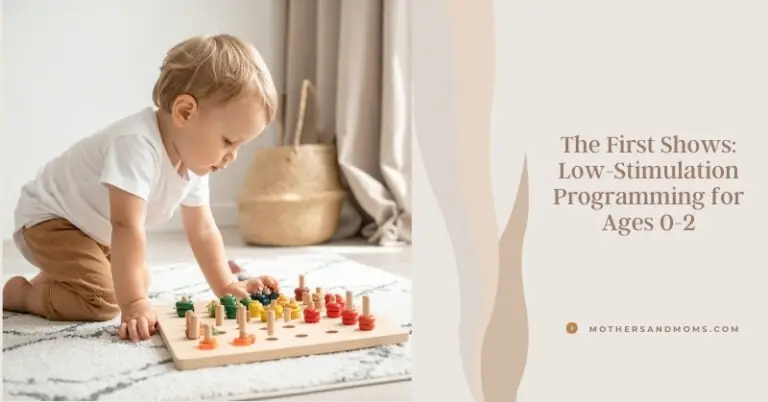
No More Meltdowns: The Best Low-Stimulation Shows for Ages 0-2
Discover the “please just let me make coffee” shows that soothe without overstimulating—from Little Bear’s storybook calm to Bob Ross’s happy little trees (yes, really).
Ages 2-4: Social-Emotional Learning Without the Chaos
Navigate the emotional rollercoaster years with shows that teach feelings, friendship, and problem-solving at a pace your toddler can actually process, plus the truth about Daniel Tiger’s magic jingles.
COMING SOON: Ages 5+: Educational Shows That Don’t Feel Like School
Find programs that spark curiosity about science, nature, and the world while maintaining that gentle pace—because learning and calm aren’t mutually exclusive.
Screen Time Guilt
Here’s what I want you to know, you’re not failing because you turn on the TV. You’re not a bad parent because your child knows who Bluey is. The fact that you’re here, reading this, trying to make thoughtful choices about what your child watches? That already makes you incredible.
The parents I’ve talked to and read about (the ones who shared their experiences, their struggles, their discoveries) they’re not perfect either. They’re just trying, like you, to do their best in a world that makes parenting really, really hard sometimes.
So yes, turn on the TV when you need to. Make your coffee. Take your shower. Answer that work email. Just maybe skip Cocomelon and put on Puffin Rock instead.
Your fifteen minutes of peace can be gentle. For both of you.
Ready to explore? Choose your child’s age group above and discover the shows that’ll actually work for your family, no judgment, just real recommendations from parents who’ve been there.